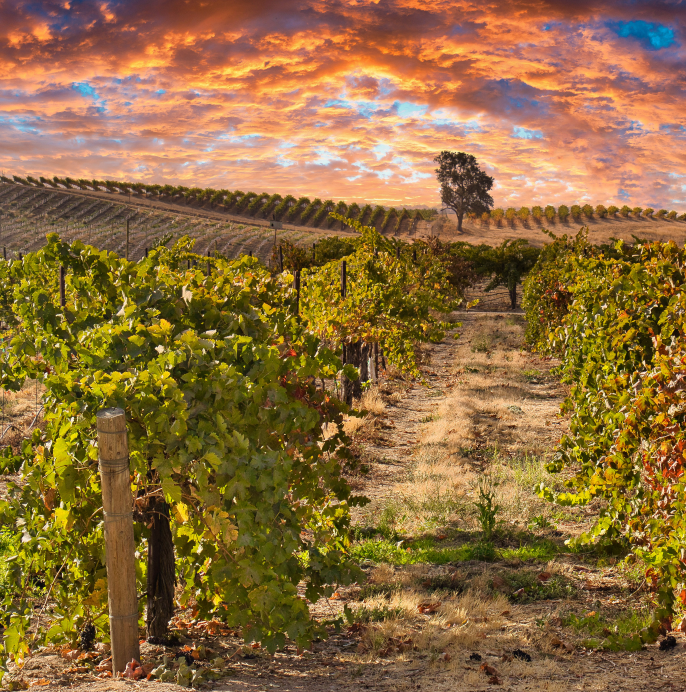
I love it when a wine lives up to its story, and the story behind this wine is a doozy: It is made from near-century-old Mourvèdre vines from the much-talked-about Enz Vineyard, a property which comprises the total vineyard acreage of California’s Lime Kiln Valley American Viticultural Area (AVA). Located in San Benito County, near Hollister, what is now the Enz Vineyard was originally planted by homesteaders in the late-1800s; the Mourvèdre was originally brought here by French immigrants, and the eight-acre plot that serves as the source for this wine dates to 1922 and is said to have been propagated from the original vine material.
It is one of several unique and historic vineyards in a portfolio assembled by Salinas-based winemaker Ian Brand, whose career we’ve been following with interest. Brand might best be dubbed a vineyard-hunter; if there’s unique source material to be had in Monterey, Santa Cruz, and the surrounding areas, chances are he’s forged a relationship with the grower and is making a wine from the site. Last year, we offered a vibrant, Monterey-sourced Albariño he makes under his La Marea label. More recently, he’s launched a series of single-vineyard bottlings from iconic vineyards under the I. Brand & Family moniker: This Mourvèdre from Enz Vineyard stole the show in a recent tasting, hinting at a world-class French red with its lavender-scented perfume and lush-yet-sinewy texture. It’s a little piece of California history, but, more important still, it’s a delicious, distinctive, well-priced wine.
With his Le P’tit Paysan and La Marea labels, both crafted in his winery in a Salinas warehouse, Ian has hit on a winning formula: find unique, often obscure California vineyards planted to varieties that make sense in those places (something many Californians ignore in their lust for Pinot Noir!), and make wines that say something about those sites. The I. Brand & Family line is especially focused on iconic vineyard sites—including both Bates Ranch and Monte Bello in the Santa Cruz Mountains—and the level of detail he provides on the Enz Vineyard is downright obsessive. From his notes:
“We’ve been watching the Enz Vineyard, tucked back in the small Lime Kiln Valley near the mouth of the Cienega Valley, for over a decade. During that time the fruit from the vineyard was taken exclusively by Ken Volk. In 2015 he let go of control of the vineyard and we were able to secure a small allotment from the 8 acre old vine Mourvèdre block. We believe this is the best block on the vineyard, and among the best, if not the best, Mourvèdre plantings on the continent. Planted in 1922 on a north facing 5-10 degree slope on heavily granitic loam. There are seams of limestone and dolomite visible from the vineyard we don’t know if that directly influences the plot.”
It’s worth noting that Bandol, arguably Mourvèdre’s “home” terroir, is a limestone-based soil. The Enz Vineyard is dry-farmed (i.e. not irrigated), with vine age approaching the century mark; the Lime Kiln Valley isn’t exactly a “cool” climate, but it does feature wide diurnal swings in temperature, with hot days and cool nights (there is an influence felt from the Monterey Bay, via a gap in the Gabilan Mountains). One of the key features of this Mourvèdre is its combination of profound depth and refreshing acidity; Brand also sought to preserve freshness further by incorporating 50% whole grape clusters in the fermentation. It was aged in neutral oak barrels for 11 months before bottling.
The 2015 Enz Vineyard Mourvèdre gives you your first hint as to what it is with its lavender/purple-tinted hue. The aromatics are deep and accented with beautiful florals: mulberry, blackberry, black cherry blossoms, lavender, wildflowers, damp forest, anise, and crushed stone. It is richly textured and nicely framed by acidity, with soft, silty tannins. It is simply delicious now: Decant it about 30 minutes before serving in Burgundy stems just above cellar temp. If you were inclined, I think it’s got about a 5-year window for cellaring, but I see no reason to wait on it. There’s terrific aromatic complexity and a spicy, savory component for grilled sausages or a slow-roasted pork shoulder (see attached recipe). Check it out!