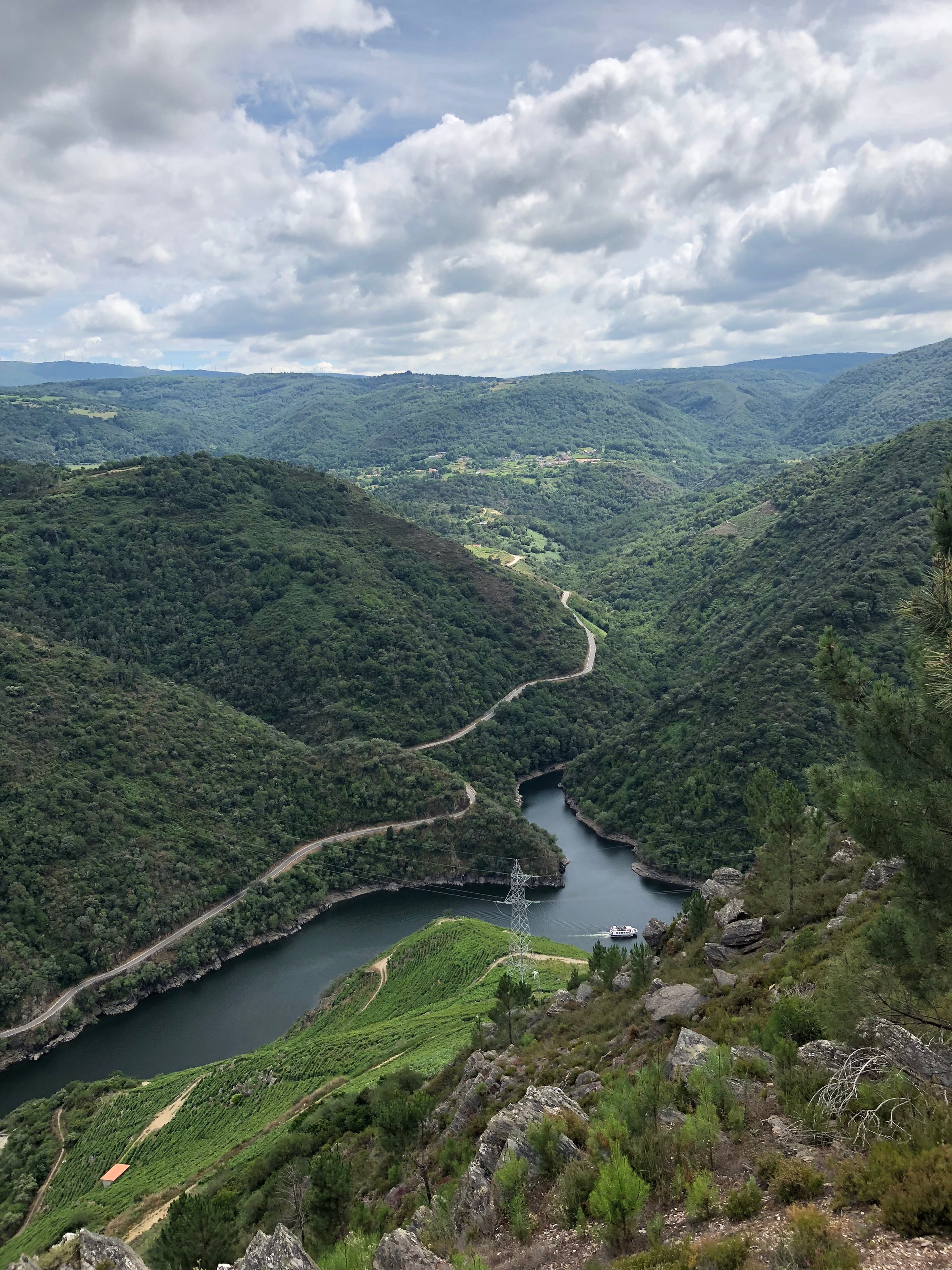
Considering that many vineyards in Spain’s Ribeira Sacra region are only accessible by boat—and are often so steep that many are outfitted with funiculars to transport grapes during harvest—it’s not surprising that many of them were abandoned. Although viticulture along serpentine Galician rivers like the Miño and the Sil dates to Roman times, historic appellations in northwest Spain such as Ribeira Sacra, Valdeorras, and Bierzo became the wine wilderness for a while—under-populated and under-appreciated, but of course teeming with potential.
Unlike, say, the similarly epic viticulture of Austria’s Danube, with its centuries of unbroken history, the Ribeira Sacra is, despite its own ancient roots, effectively a new frontier. One exciting example of this is Finca Millara, a passion project of recent creation by Fernando de Santiago, who, starting in 2000, started acquiring vineyards from small local growers in the Miño River hamlet of A Millara. With the help of local winemaking guru Raúl Pérez—himself a native of nearby Bierzo and a fast-rising star on the international wine scene—de Santiago has created a singular lineup of authentic, terroir-expressive wines that are wowing critics and consumers alike. Today’s red, sourced from old vines just outside the Ribeira Sacra DO boundary, wowed us and will wow you as well. Driven by the native Mencía grape, it shows off that variety’s unique mix of deep, dark-toned fruit and bright, buoyant texture. It’s got lots of crunch and pop while also boasting soft tannins and moderate alcohol. I’d put it right up there with Cru Beaujolais as a wine of the moment—a great example of how red wine can have profound depth without the accompanying weight. Find a spot for it in your rotation: I guarantee you will not regret it!
To create—or, perhaps more accurately, assemble—Finca Millara, Fernando de Santiago had to reach out to hundreds of small property owners to put together a workable collection of vineyards. Most of the sites he acquired, some of which were abandoned but still clung to the slopes with the help of narrow stone terraces called bancadas, have been rejuvenated through years of painstaking work. There’s now a modern winemaking facility on site as well, and when Raúl Pérez came onboard, he began vinifying vineyard parcels separately to express the character of different sites—the Finca Millara lineup reflects this vineyard-first approach, and the “El Prohibido” bottling, as its name suggests, is from an old-vine parcel that doesn’t fall within the official parameters of the Ribeira Sacra DO. Situated at 1,100 feet in soils dominated by granite, it is a site that, perhaps not surprisingly, delivers wines of perfume, power, and freshness.
The prodigiously bearded Raúl Pérez notes that grapes for “El Prohibido” were 100% destemmed and fermented using only native yeasts, with malolactic fermentation (a secondary fermentation which converts malic acid to lactic acid) occurring in barrel. Overall, the wine is aged just a year before bottling, with 6 months spent in tank and four months in French oak.
Freshness and purity are the keywords here. In the glass, the 2014 “El Prohibido” is a deep, saturated ruby with magenta highlights at the rim, but the near-inkiness of its color is deceptive: this is a medium-bodied wine with lots of brightness and focus, not something chunkier/richer. The highly perfumed nose offers up lots of black raspberry, pomegranate, cranberry, damp violet, tobacco, and wet-stone aromas, which carry through to the vibrant palate. Tannins are soft and sweet, while the acidity is mouth-watering and invigorating, readying you for a bite of food. This is a bottle to decant 30 minutes before serving at 60-65 degrees in Burgundy stems (maybe a little cooler to accentuate its fruit and soften the acidity) and enjoy with a rustic, well-charred, herb-rubbed flank steak as in the attached recipe. I want to have a case of this wine on-hand to dip into over the next few years—it will make a great short-term ager and an incredibly versatile partner with food. Store it next to your favorite Cru Beaujolais and alternate—you’ll be glad you did!